

What Types Of Elements Are In The Makeup Of The Following Compound Molecular
Learning Outcomes
- Define ionic and molecular (covalent) compounds
- Predict the type of compound formed from elements based on their location inside the periodic table
- Determine formulas for simple ionic compounds
In ordinary chemic reactions, the nucleus of each atom (and thus the identity of the element) remains unchanged. Electrons, however, can be added to atoms by transfer from other atoms, lost by transfer to other atoms, or shared with other atoms. The transfer and sharing of electrons amid atoms govern the chemical science of the elements. During the formation of some compounds, atoms gain or lose electrons, and form electrically charged particles called ions (Figure 1).
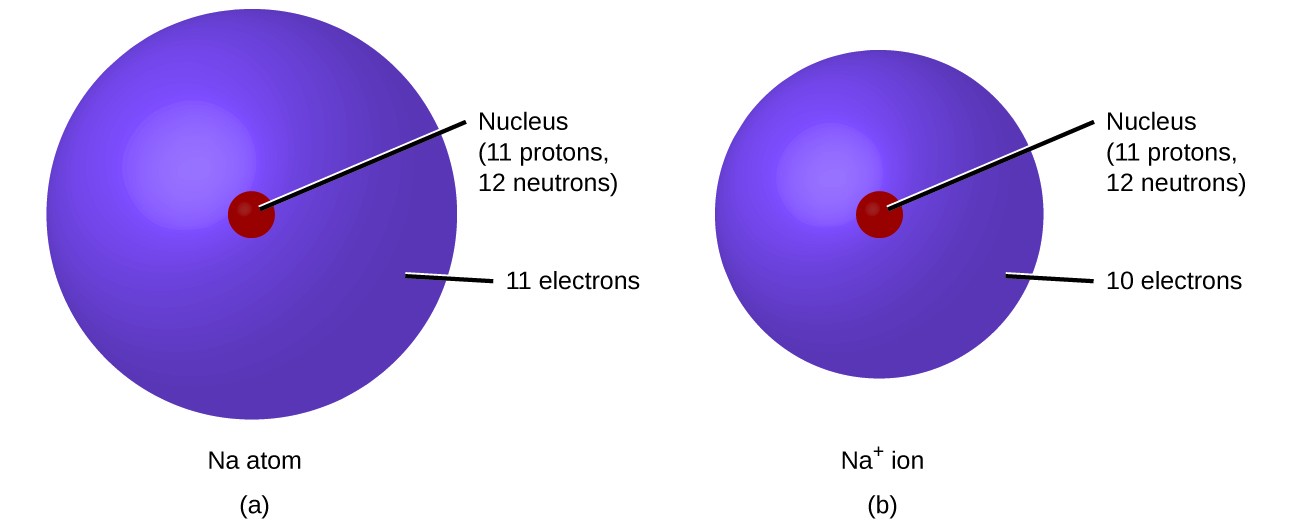
Figure one. (a) A sodium atom (Na) has equal numbers of protons and electrons (11) and is uncharged. (b) A sodium cation (Na+) has lost an electron, so it has one more proton (11) than electrons (10), giving information technology an overall positive charge, signified past a superscripted plus sign.
You tin can utilise the periodic table to predict whether an atom will class an anion or a cation, and you tin oftentimes predict the charge of the resulting ion. Atoms of many main-group metals lose enough electrons to leave them with the same number of electrons equally an atom of the preceding noble gas. To illustrate, an atom of an alkali metal (grouping ane) loses one electron and forms a cation with a 1+ charge; an element of group ii (grouping 2) loses two electrons and forms a cation with a 2+ charge, and so on. For example, a neutral calcium atom, with twenty protons and 20 electrons, readily loses 2 electrons. This results in a cation with 20 protons, 18 electrons, and a 2+ accuse. It has the same number of electrons as atoms of the preceding noble gas, argon, and is symbolized [latex]\text{Ca}^{two+}[/latex]. The name of a metal ion is the same every bit the name of the metal cantlet from which information technology forms, and so [latex]\text{Ca}^{ii+}[/latex] is called a calcium ion.
When atoms of nonmetal elements form ions, they generally gain enough electrons to requite them the same number of electrons as an atom of the side by side noble gas in the periodic table. Atoms of group 17 proceeds one electron and form anions with a i− charge; atoms of group sixteen gain two electrons and form ions with a 2− charge, and so on. For example, the neutral bromine atom, with 35 protons and 35 electrons, can proceeds one electron to provide it with 36 electrons. This results in an anion with 35 protons, 36 electrons, and a 1− charge. It has the aforementioned number of electrons equally atoms of the adjacent element of group 0, krypton, and is symbolized [latex]\text{Br}^{-}[/latex]. (A discussion of the theory supporting the favored condition of noble gas electron numbers reflected in these predictive rules for ion formation is provided in a afterward module of this text.)
Note the usefulness of the periodic table in predicting likely ion formation and charge (Effigy 2). Moving from the far left to the right on the periodic table, main-group elements tend to grade cations with a charge equal to the grouping number. That is, group 1 elements form 1+ ions; group 2 elements form 2+ ions, and so on. Moving from the far right to the left on the periodic table, elements often class anions with a negative accuse equal to the number of groups moved left from the noble gases. For example, group 17 elements (one group left of the noble gases) form 1− ions; grouping xvi elements (two groups left) form ii− ions, and so on. This trend can be used equally a guide in many cases, but its predictive value decreases when moving toward the center of the periodic table. In fact, transition metals and some other metals often showroom variable charges that are not predictable by their location in the table. For example, copper can form ions with a 1+ or 2+ charge, and iron tin form ions with a 2+ or 3+ charge.
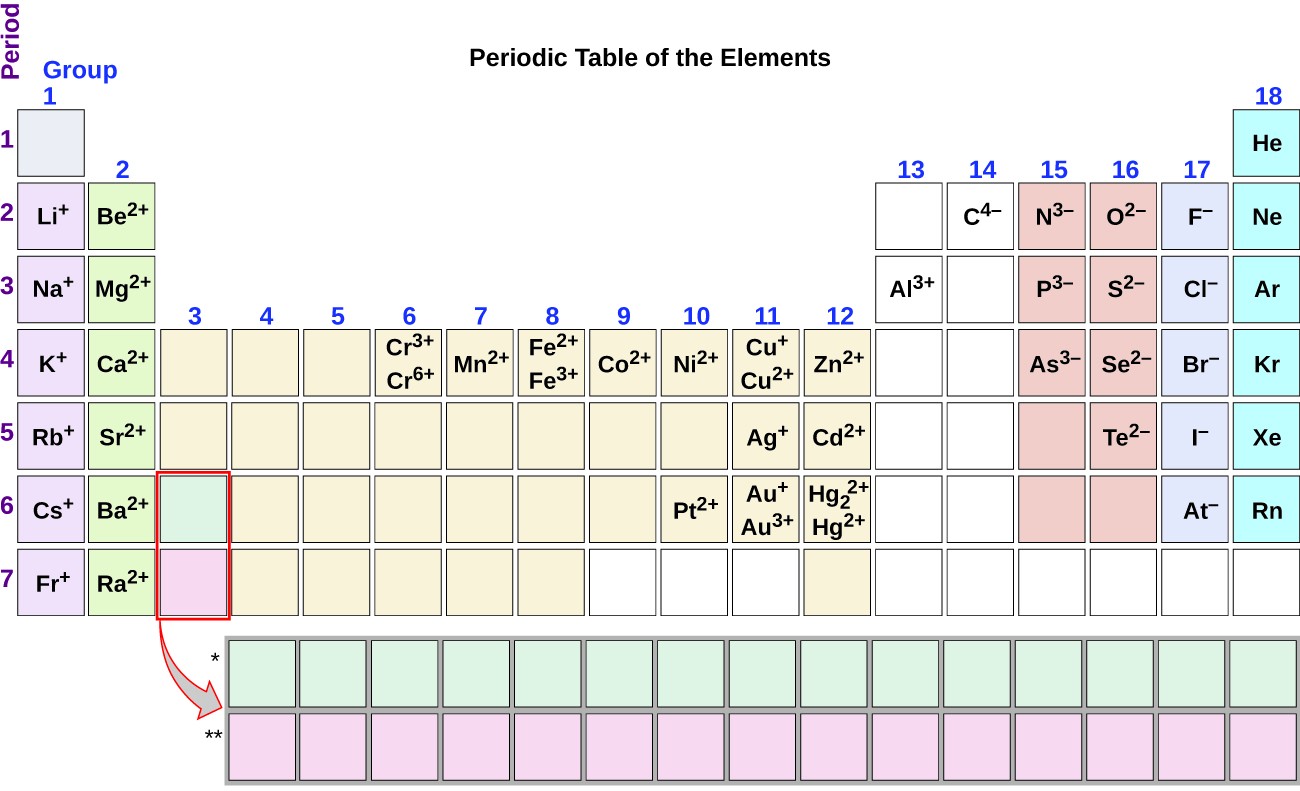
Figure 2. Some elements exhibit a regular pattern of ionic charge when they grade ions.
Instance one:Composition of Ions
An ion found in some compounds used equally antiperspirants contains 13 protons and 10 electrons. What is its symbol?
Show Solution
Because the number of protons remains unchanged when an atom forms an ion, the diminutive number of the element must be 13. Knowing this lets us apply the periodic table to identify the chemical element as Al (aluminum). The Al atom has lost three electrons and thus has iii more positive charges (13) than it has electrons (10). This is the aluminum cation, [latex]\text{Al}^{3+}[/latex].
Check Your Learning
Give the symbol and proper noun for the ion with 34 protons and 36 electrons.
Testify Solution
[latex]\text{Se}^{2-}[/latex], the selenide ion
Example 2:Formation of Ions
Magnesium and nitrogen react to form an ionic compound. Predict which forms an anion, which forms a cation, and the charges of each ion. Write the symbol for each ion and name them.
Check Your Learning
Aluminum and carbon react to class an ionic compound. Predict which forms an anion, which forms a cation, and the charges of each ion. Write the symbol for each ion and proper noun them.
Evidence Solution
Al will class a cation with a charge of 3+: Al3+, an aluminum ion. Carbon volition form an anion with a charge of iv−: C4−, a carbide ion.
The ions that we have discussed so far are called monatomic ions, that is, they are ions formed from merely ane atom. Nosotros also find many polyatomic ions. These ions, which human action as detached units, are electrically charged molecules (a group of bonded atoms with an overall charge). Some of the more of import polyatomic ions are listed in Table 1. Oxyanions are polyatomic ions that contain one or more oxygen atoms. At this point in your study of chemical science, you should memorize the names, formulas, and charges of the near common polyatomic ions. Because you will apply them repeatedly, they will soon go familiar.
| Table 1. Common Polyatomic Ions | ||||||
|---|---|---|---|---|---|---|
| Charge | Proper name | Formula | Charge | Name | Formula | |
| 1+ | ammonium | [latex]{\text{NH}}_{four}{}^{+}[/latex] | 1− | permanganate | [latex]{\text{MnO}}_{4}{}^{-}[/latex] | |
| 1− | acetate | [latex]{\text{C}}_{2}{\text{H}}_{3}{\text{O}}_{2}{}^{-}[/latex] | ane− | hydrogen carbonate, or bicarbonate | [latex]{\text{HCO}}_{three}{}^{-}[/latex] | |
| 1− | cyanide | [latex]\text{CN}^-[/latex] | 2− | carbonate | [latex]{\text{CO}}_{3}{}^{2-}[/latex] | |
| 1− | hydroxide | [latex]\text{OH}^-[/latex] | 2− | peroxide | [latex]{\text{O}}_{2}{}^{2-}[/latex] | |
| 1− | nitrate | [latex]{\text{NO}}_{three}{}^{-}[/latex] | ane− | hydrogen sulfate, or bisulfate | [latex]{\text{HSO}}_{4}{}^{-}[/latex] | |
| 1− | nitrite | [latex]{\text{NO}}_{2}{}^{-}[/latex] | 2− | sulfate | [latex]{\text{SO}}_{four}{}^{2-}[/latex] | |
| 1− | perchlorate | [latex]{\text{ClO}}_{4}{}^{-}[/latex] | ii− | sulfite | [latex]{\text{And so}}_{3}{}^{ii-}[/latex] | |
| 1− | chlorate | [latex]{\text{ClO}}_{3}{}^{-}[/latex] | 1− | dihydrogen phosphate | [latex]{\text{H}}_{ii}{\text{PO}}_{4}{}^{-}[/latex] | |
| 1− | chlorite | [latex]{\text{ClO}}_{ii}{}^{-}[/latex] | 2− | hydrogen phosphate | [latex]{\text{HPO}}_{iv}{}^{two-}[/latex] | |
| 1− | hypochlorite | [latex]\text{ClO}^-[/latex] | 3− | phosphate | [latex]{\text{PO}}_{four}{}^{3-}[/latex] | |
Notation that there is a arrangement for naming some polyatomic ions; -ate and -ite are suffixes designating polyatomic ions containing more or fewer oxygen atoms. Per- (short for "hyper") and hypo- (significant "under") are prefixes meaning more oxygen atoms than -ate and fewer oxygen atoms than -ite, respectively. For instance, perchlorate is [latex]{\text{ClO}}_{4}{}^{-}[/latex], chlorate is [latex]{\text{ClO}}_{three}{}^{-}[/latex], chlorite is [latex]{\text{ClO}}_{2}{}^{-}[/latex] and hypochlorite is [latex]{\text{ClO}^{-}}[/latex]. Unfortunately, the number of oxygen atoms corresponding to a given suffix or prefix is not consistent; for example, nitrate is [latex]{\text{NO}}_{3}{}^{-}[/latex] while sulfate is [latex]{\text{And then}}_{four}{}^{2-}.[/latex] This will be covered in more item in the side by side module on nomenclature.
The nature of the attractive forces that agree atoms or ions together inside a compound is the basis for classifying chemical bonding. When electrons are transferred and ions form, ionic bonds result. Ionic bonds are electrostatic forces of attraction, that is, the bonny forces experienced between objects of contrary electric charge (in this case, cations and anions). When electrons are "shared" and molecules class, covalent bonds effect. Covalent bonds are the bonny forces between the positively charged nuclei of the bonded atoms and 1 or more pairs of electrons that are located between the atoms. Compounds are classified as ionic or molecular (covalent) on the basis of the bonds present in them.
Ionic Compounds
When an element equanimous of atoms that readily lose electrons (a metal) reacts with an element equanimous of atoms that readily gain electrons (a nonmetal), a transfer of electrons normally occurs, producing ions. The compound formed by this transfer is stabilized by the electrostatic attractions (ionic bonds) between the ions of opposite charge present in the compound. For example, when each sodium atom in a sample of sodium metal (group 1) gives upwards 1 electron to course a sodium cation, Na+, and each chlorine atom in a sample of chlorine gas (grouping 17) accepts i electron to form a chloride anion, Cl−, the resulting compound, NaCl, is composed of sodium ions and chloride ions in the ratio of 1 Na+ ion for each Cl− ion. Similarly, each calcium atom (grouping ii) can requite up 2 electrons and transfer one to each of two chlorine atoms to form CaCl2, which is composed of Caii+ and Cl− ions in the ratio of one Ca2+ ion to two Cl− ions.
A chemical compound that contains ions and is held together by ionic bonds is called an ionic chemical compound. The periodic table can help the states recognize many of the compounds that are ionic: When a metal is combined with i or more nonmetals, the compound is usually ionic. This guideline works well for predicting ionic compound germination for well-nigh of the compounds typically encountered in an introductory chemical science course. However, it is not always truthful (for case, aluminum chloride, AlCl3, is non ionic).
Y'all tin can oftentimes recognize ionic compounds because of their properties. Ionic compounds are solids that typically melt at loftier temperatures and boil at even higher temperatures. For instance, sodium chloride melts at 801 °C and boils at 1413 °C. (Every bit a comparison, the molecular chemical compound water melts at 0 °C and boils at 100 °C.) In solid form, an ionic chemical compound is not electrically conductive because its ions are unable to flow ("electricity" is the catamenia of charged particles). When molten, however, it can conduct electricity because its ions are able to movement freely through the liquid (Figure 3).
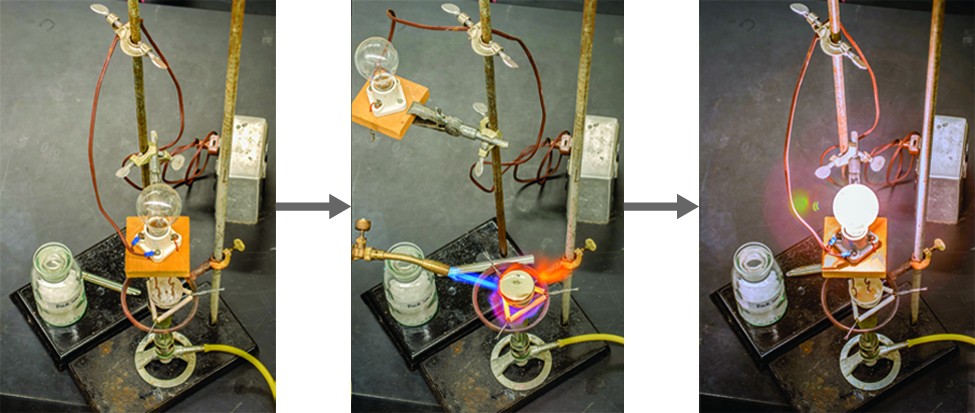
Figure 3. Sodium chloride melts at 801 °C and conducts electricity when molten. (credit: modification of work past Mark Blaser and Matt Evans)
Watch this video to see a mixture of salts melt and conduct electricity. (Annotation that the video has no narration. You tin access the audio description using the widget below the video.)
Yous tin view the transcript for the audio description of "Electrical conductivity molten salt" here (opens in new window).
In every ionic compound, the full number of positive charges of the cations equals the total number of negative charges of the anions. Thus, ionic compounds are electrically neutral overall, even though they contain positive and negative ions. We can use this observation to assist united states write the formula of an ionic compound. The formula of an ionic compound must have a ratio of ions such that the numbers of positive and negative charges are equal.
Example iii:Predicting the Formula of an Ionic Compound
The gemstone sapphire (Figure iv) is mostly a chemical compound of aluminum and oxygen that contains aluminum cations, Althree+, and oxygen anions, O2−. What is the formula of this compound?
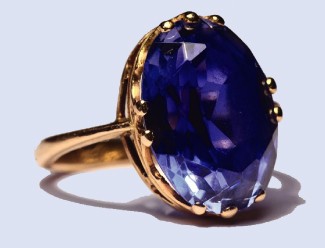
Figure iv. Although pure aluminum oxide is colorless, trace amounts of iron and titanium give blueish sapphire its characteristic colour. (credit: modification of work past Stanislav Doronenko)
Show Solution
Considering the ionic compound must exist electrically neutral, it must have the same number of positive and negative charges. Ii aluminum ions, each with a charge of 3+, would give us six positive charges, and three oxide ions, each with a charge of 2−, would give us six negative charges. The formula would be AliiO3.
Check Your Learning
Predict the formula of the ionic chemical compound formed between the sodium cation, Na+, and the sulfide anion, S2−.
Many ionic compounds incorporate polyatomic ions (Tabular array 1) every bit the cation, the anion, or both. As with uncomplicated ionic compounds, these compounds must also be electrically neutral, and so their formulas tin can be predicted past treating the polyatomic ions equally discrete units. We use parentheses in a formula to betoken a grouping of atoms that behave as a unit. For example, the formula for calcium phosphate, 1 of the minerals in our bones, is [latex]\text{Ca}_{three}(\text{PO}_{4})_{2}[/latex]. This formula indicates that at that place are three calcium ions [latex](\text{Ca}^{two+})[/latex] for every two phosphate [latex]\left({\text{PO}}_{iv}{}^{3-}\right)[/latex] groups. The [latex]{\text{PO}}_{iv}{}^{3-}[/latex] groups are discrete units, each consisting of ane phosphorus atom and four oxygen atoms, and having an overall charge of three-. The chemical compound is electrically neutral, and its formula shows a total count of three Ca, two P, and eight O atoms.
Example 4:Predicting the Formula of a Chemical compound with a Polyatomic Anion
Blistering powder contains calcium dihydrogen phosphate, an ionic compound composed of the ions Caii+ and [latex]{\text{H}}_{2}{\text{PO}}_{4}{}^{-}[/latex]. What is the formula of this compound?
Bear witness Solution
The positive and negative charges must residuum, and this ionic compound must be electrically neutral. Thus, we must have two negative charges to balance the ii+ charge of the calcium ion. This requires a ratio of one Catwo+ ion to ii [latex]{\text{H}}_{2}{\text{PO}}_{four}{}^{-}[/latex] ions. We designate this past enclosing the formula for the dihydrogen phosphate ion in parentheses and calculation a subscript 2. The formula is Ca(HtwoPOfour)ii.
Check Your Learning
Predict the formula of the ionic chemical compound formed between the lithium ion and the peroxide ion, [latex]{\text{O}}_{2}{}^{2-}[/latex] (Hint: Apply the periodic table to predict the sign and the charge on the lithium ion.)
Considering an ionic compound is not fabricated up of single, discrete molecules, it may non be properly symbolized using a molecular formula. Instead, ionic compounds must be symbolized by a formula indicating the relative numbers of its constituent cations. For compounds containing only monatomic ions (such as [latex]\text{NaCl}[/latex]) and for many compounds containing polyatomic ions (such as [latex]\text{CaSO}_{4})[/latex], these formulas are just the empirical formulas introduced earlier. However, the formulas for some ionic compounds containing polyatomic ions are not empirical formulas. For example, the ionic compound sodium oxalate is comprised of [latex]\text{Na}^{+}[/latex] and [latex]{\text{C}}_{two}{\text{O}}_{4}{}^{2-}[/latex] ions combined in a 2:i ratio, and its formula is written every bit [latex]\text{Na}_{2}\text{C}_{ii}\text{O}_{4}[/latex]. The subscripts in this formula are not the smallest-possible whole numbers, every bit each can be divided by 2 to yield the empirical formula, [latex]\text{NaCO}_{two}[/latex]. This is not the accustomed formula for sodium oxalate, however, as it does not accurately correspond the compound's polyatomic anion, [latex]{\text{C}}_{2}{\text{O}}_{4}{}^{2-}[/latex].
Molecular Compounds
Many compounds exercise non contain ions but instead consist solely of discrete, neutral molecules. These molecular compounds (covalent compounds) result when atoms share, rather than transfer (gain or lose), electrons. Covalent bonding is an important and all-encompassing concept in chemistry, and it will be treated in considerable particular in a later module of this text. We can ofttimes place molecular compounds on the basis of their concrete properties. Under normal conditions, molecular compounds ofttimes exist as gases, depression-humid liquids, and low-melting solids, although many of import exceptions be.
Whereas ionic compounds are normally formed when a metallic and a nonmetal combine, covalent compounds are commonly formed past a combination of nonmetals. Thus, the periodic table can help united states of america recognize many of the compounds that are covalent. While we can use the positions of a compound'southward elements in the periodic tabular array to predict whether it is ionic or covalent at this point in our study of chemical science, y'all should be aware that this is a very simplistic arroyo that does not account for a number of interesting exceptions. Shades of grayness be between ionic and molecular compounds, and yous'll learn more about those later.
Example 5:Predicting the Blazon of Bonding in Compounds
Predict whether the following compounds are ionic or molecular:
- KI, the chemical compound used as a source of iodine in tabular array salt
- H2Oii, the bleach and disinfectant hydrogen peroxide
- CHCl3, the anesthetic chloroform
- LiiiCO3, a source of lithium in antidepressants
Cheque Your Learning
Using the periodic table, predict whether the following compounds are ionic or covalent:
- Thentwo
- CaF2
- North2H4
- Al2(And then4)three
Key Concepts and Summary
Metals (particularly those in groups 1 and 2) tend to lose the number of electrons that would get out them with the same number of electrons as in the preceding element of group 0 in the periodic tabular array. By this ways, a positively charged ion is formed. Similarly, nonmetals (especially those in groups 16 and 17, and, to a lesser extent, those in Group 15) tin proceeds the number of electrons needed to provide atoms with the aforementioned number of electrons equally in the next noble gas in the periodic table. Thus, nonmetals tend to form negative ions. Positively charged ions are called cations, and negatively accuse ions are chosen anions. Ions can exist either monatomic (containing but ane cantlet) or polyatomic (containing more one atom).
Compounds that comprise ions are called ionic compounds. Ionic compounds generally grade from metals and nonmetals. Compounds that do not contain ions, simply instead consist of atoms bonded tightly together in molecules (uncharged groups of atoms that behave as a single unit of measurement), are called covalent compounds. Covalent compounds usually form from two nonmetals.
Try It
- Using the periodic table, predict whether the post-obit chlorides are ionic or covalent: KCl, NCliii, ICl, MgCl2, PCl5, and CCl4.
- Using the periodic table, predict whether the post-obit chlorides are ionic or covalent: SiCl4, PCl3, CaCltwo, CsCl, CuClii, and CrCliii.
- For each of the following compounds, country whether it is ionic or covalent. If it is ionic, write the symbols for the ions involved:
- NF3
- BaO,
- (NH4)twoCOiii
- Sr(H2PO4)2
- IBr
- NaiiO
- For each of the post-obit compounds, state whether it is ionic or covalent, and if information technology is ionic, write the symbols for the ions involved:
- KClOfour
- MgC2H3O2
- H2S
- Ag2Southward
- NtwoCl4
- Co(NO3)ii
- For each of the following pairs of ions, write the symbol for the formula of the compound they volition form:
- Ca2+, S2-
- [latex]{\text{NH}}_{4}{}^{+}[/latex], [latex]{\text{So}}_{4}{}^{2-}[/latex]
- Al3+, Br–(d) Na+, [latex]{\text{HPO}}_{four}{}^{2-}[/latex] (eastward) Mg2+, [latex]{\text{PO}}_{4}{}^{3-}[/latex]
- For each of the post-obit pairs of ions, write the symbol for the formula of the chemical compound they will form:
- Grand+, O2-
- [latex]{\text{NH}}_{iv}{}^{+}[/latex], [latex]{\text{PO}}_{4}{}^{three-}[/latex]
- Al3+, Oii-
- Na+, [latex]{\text{CO}}_{three}{}^{2-}[/latex]
- Ba2+, [latex]{\text{PO}}_{4}{}^{3-}[/latex]
Glossary
covalent bond:attractive forcefulness between the nuclei of a molecule's atoms and pairs of electrons between the atoms
covalent compound:(as well, molecular chemical compound) composed of molecules formed past atoms of two or more than different elements
ionic bail:electrostatic forces of attraction between the oppositely charged ions of an ionic compound
ionic compound:compound equanimous of cations and anions combined in ratios, yielding an electrically neutral substance
molecular compound:(besides, covalent chemical compound) composed of molecules formed by atoms of 2 or more different elements
monatomic ion:ion composed of a unmarried atom
oxyanion:polyatomic anion composed of a central atom bonded to oxygen atoms
polyatomic ion:ion composed of more one atom
Source: https://courses.lumenlearning.com/chemistryformajors/chapter/molecular-and-ionic-compounds-2/
Posted by: dorseyaune1973.blogspot.com
0 Response to "What Types Of Elements Are In The Makeup Of The Following Compound Molecular"
Post a Comment